


Sandi Murovec - "Life is beautiful – skiing is both"
Text: Martin Obermayr | Photos: Sandi Murovec
He's a film producer, author, and has taken the skiing technique of his fellow Slovenian, Tina Maze, to new heights. Sandi Murovec, ski coach, is a tireless visionary and ambassador for snow sports. He shares his experiences with us and offers a glimpse into the future.

Insight Magazine: You worked with Tina Maze, who holds the world record in the overall World Cup with 2,414 points. How did that come about?
Sandi Murovec: I met Tina in 1999. She was 16 at the time and considered a great talent on the national team. We stayed in touch on and off ever since. This intensified in 2008 when "Team to a Maze" was founded – a support group where everything was tailored to Tina. Her partner and fitness coach, Andrea Massi, was the team manager, there was also a ski technician, and I worked with Tina on her skiing technique from May until the end of October. Later, other people joined us.
What did you learn from this collaboration? Sandi: First, that you're never good enough. There's always room for improvement. Second, development in skiing never stops. Just when you think, "Wow, now I'm going to fly there," something new comes along – every season. And third: When you work with a champion like that, you're in a completely different world. Anyone who skis at this high level simply has to be different.
What do you mean?
Sandi: Every day I learned something new. How patient you have to be. How important a good personal relationship is. How to communicate with such a high-caliber athlete. And above all, how to help her reach an even higher level. For example: I saw that she...
Her center of gravity had to be lowered. It was clear she needed more strength. So she had to strengthen all the muscles in her legs, core, and back. And then I had to convince her that it takes time to see the effects of the change. It's always a chain of interconnected things – a big challenge, but also a great joy.
Is there such a thing as the perfect swing?
Sandi: There's physics and its facts – you can't get around that. But every athlete is different: in terms of musculature, body characteristics, genetics, etc. Therefore, you can't simply copy someone. In Tina's case, we couldn't say, "Mikhaela Shiffrin's slalom technique is the best, and we'll adopt that." Tina's problem was that she skied with a slightly wider stance than Mikhaela and therefore had to cover more ground. That cost her about two hundredths of a second per gate. With 55 gates, that's 1.1 seconds – and that was precisely the gap she was usually at. So we had to work on Tina's overall strategy.
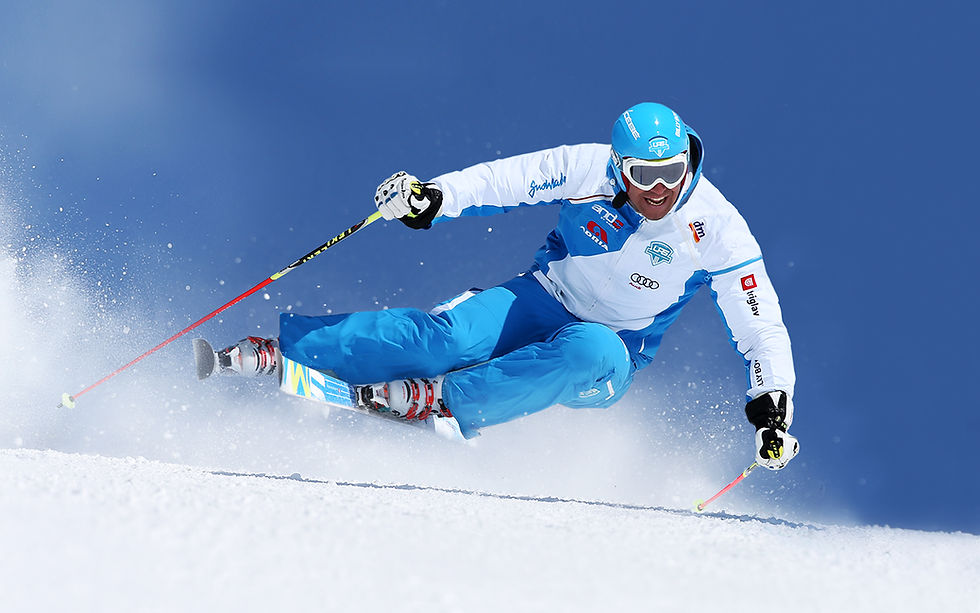
How do you convince someone to take a completely new path? Sandi: It only works through unconditional trust. I analyzed her skiing technique and explained the developments I see in the World Cup and where I see her potential. She then followed my vision and trusted my understanding of technique.
Tina has won everything: from the overall World Cup title to two Olympic and four World Championship gold medals, and victories in all five disciplines. What role did you play in her success? Sandi: It would be presumptuous to say anything now. Only she can say that. At the end of the day, she had to deliver on the slopes. Although I must say that Andrea Massi was the mastermind behind this brilliant project. I was personally very happy that after Tina's career, we produced the ski film "7 to Heaven"—in German, "7 zum Siegen" (7 to Victory). In it, she talks about how I helped her improve her right turn. And she also says that it was the best experience she had with Muri—that's the greatest compliment for me.
In the high-quality 45-minute film, you describe 7 axioms that were crucial to Tina's success: These have such evocative names as "Open Attack", "The Arm of Glory", "Battle Control", etc. What was your goal?
Sandi: We wanted to show how Tina has pushed her limits even further and what details we've been working on. Of course, these aren't all the points, but they should also encourage the average skier to explore their own limits.
to delve into technology. The film's message is: Only the best know and share the future.
What are you currently working on?
Sandi: My current project is a book with the Slovenian title "BITI MOJSTR-SKI," which translates roughly as "How to Become a Ski Master." It's a master manual in which I've packed all my knowledge about skiing, from beginner to racer. The 7 axioms from the film are also included, but only a small part of it. Unfortunately, the book is currently only available in Slovenian and Chinese—in China, everyone wants everything related to skiing right now. I hope the book will also be published in German and English. German, in particular, is the most important language in skiing and ski instruction.

What are the contents of the book?
Sandi: It's structured as a dialogue between the reader and me. I try to address everything as directly and essentially as possible: for example, "Top performance equals top understanding." That means we have to make training and instruction understandable, because that's the only way to implement things. Or: "We are always learning. That never stops." Or: "Less is more." The ski instruction program "UPS," which I developed, is also presented. There are also plenty of technical tips and theory. And a large chapter focuses on the skiing technique of young racers—my 12-year-old daughter demonstrates the exercises.
Will she one day follow in Tina Maze's footsteps? Sandi: It's impossible to say. I'm happy for her that she enjoys racing and loves skiing as much as I do. But that's also a point in the book: "What's the difference between talent and an exceptional feel for skiing?" Talent is much more complex than just being good on skis – as I've already mentioned, it's about genes, muscle structure, etc.
You're also a member of the Slovenian demonstration ski team and an advisor to the International Ski Instructors Association. What will ski instruction look like in 2025? What expectations will guests have? Sandi: I've been working on this question for 15 years in my UPS program, and that won't change by 2025. The expectations of the "average" skier are quite high. Everyone buys equipment along with certain promises – something like: "With these skis, I can ski even faster, more beautifully, more efficiently." But many ski schools aren't ready for this approach and rely on traditional concepts, if I may be honest.
How can lessons be structured differently?
Sandi: My approach is to make learning more efficient with the help of specialized equipment. After all, the physical prerequisites haven't changed dramatically in recent years. Evolution doesn't work that fast or that quickly. It's still skiing and obeys certain physical laws. For me, skiing is very similar to inline skating. The question I asked myself was: "Why do people learn to inline skate so quickly, but when you put them on skis, it takes forever?" Even though the movements are almost the same.
What is your solution?
Sandi: We need to completely change our mindset. The programs need to be more interesting and exciting; people need to learn the sport faster, experience more adrenaline, and have more fun. They don't need an extra boss bossing them around in their free time. A milestone for me in this regard was teaching children. We don't use complicated explanations about movements and postures. We tell them, "Make a pizza!" "Make fries!" Why don't we do that with adults?
Sounds exciting, but do you really think that will work?
Sandi: Absolutely, we've already developed characters and names for that – feel free to write them down: Straitjacket, Superman, Happy Man, Tightrope Walker, Bungee, Nutcracker. And people really like it. If I tell them, "Hey, do it like Superman," I don't need to explain what I mean. Everyone knows. The same goes for "Straitjacket." Of course, you have to see all of this in the overall context of the UPS program. But we should definitely move more in this direction in the future. And we already have all the equipment, like cones, bungee cords, balls, etc., for exciting lessons. We just need to use it better. Forty or fifty years ago, people enjoyed skiing – without all this stuff. Why shouldn't they enjoy it today?
Do smart technologies and gadgets also play a role in this regard?
Sandi: To put it simply: A leg is still a leg, and skiing is a physical process. No matter what you measure, no app, no gadget can solve your problem. You only get information about where you're not good. You can't just buy a tool and automatically become a better skier. You have to earn it. Of course, digital technologies can be a perfect support in training. But our main task isn't to develop the best possible app, but to improve the programs – that's something completely different.
What is the most important area?
Sandi: Where we have big problems is speed control – regardless of the skier's level. Too many people rely on today's skis, which are much faster than they used to be. And if you can't handle the speed, you endanger yourself and everyone around you. But here, too, the main goal remains learning through play. I found a nice saying for that: "Life is beautiful – skiing is both." So, skiing is life, and it's beautiful.
Comments